











Churches tackle school bullying

posted on December 1, 2005 in News

Share : 

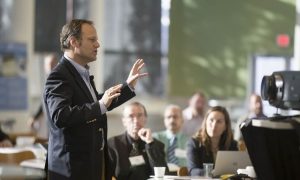
An ecumenical group gathered in Winnipeg to discuss the challenges of bullying and how the church can help stop it. As an initiative of the Presbyterian Church's Child and Youth Advisory Committee, formed in 2002, the Canadian Ecumenical Anti-Bullying Initiative created steps it could take to raise awareness of the problem.

» More

Joe Reed moves on from Central America

posted on December 1, 2005 in News

Share : 

In 1985, the Presbyterian Church had no partners in mission in Central America and no missionary presence. So the church sent Rev. Joe Reed to determine what might be done. Twenty years later, Reed is preparing to return to Canada, leaving behind three full-time missionaries in a more peaceful region where churches are involved in ministry in different contexts with new challenges, including poverty and economic development.

» More

One step forward, two steps back

posted on December 1, 2005 in News

Share : 

The UN's commission on Human Rights met in March where a statement was made by the chairman that was highly critical of the situation in Colombia. The statement is what John Lewis, KAIROS' international human rights specialist for Latin America, calls a victory for grassroots initiatives working towards peace. "There is a vibrant civil society in Colombia and it needs as much support as the international community can give it," he said. "They're the ones who will bring people together and defend human rights." KAIROS stands for Canadian Ecumenical Justice Initiatives, which supports peace-building programs in Colombia.

» More

Colombia's indigenous groups caught in the middle

No end in sight to dirty civil war

posted on December 1, 2005 in News

Share : 

Victoria Neuta's dark, warm eyes look to the floor before she speaks. She is thinking of the conflict in her country and the perils that fighting for peace can bring. As coordinator of women's affairs for the National Indigenous Organization in Colombia (ONIC), Neuta helps indigenous Colombians negotiate land disputes with the government, and supports the work of women within their communities. She has watched as indigenous men and women are pushed off their land, are wrongfully arrested and raped, have their freedoms restricted, disappear and are even killed. She knows her work is dangerous. "When we go out, we know something could happen," said Neuta, speaking through a translator during a recent visit to Toronto. "But I don't think about it. We just continue with our work."

» More

Historical but evolving

Huron-Perth is a haven in many ways

posted on December 1, 2005 in Presbytery Profile

Share : 

The Presbytery of Huron-Perth is situated in an almost magical slice of Southern Ontario heaven. Tourists, summer cottagers, retirees and long-established small-town folks enjoy the perks of living in this paradise, and file through the doors of the presbytery's 24 churches (in 19 charges). Only three of those lie vacant. While some congregations attract 15 to 50 people on a Sunday, there are others, like St. Mary's that holds two services for its 230 weekly parishioners (in a town of 6,200) and Knox, Listowel, which welcomes 148 worshippers in a town of 5,400.

» More

Portrait of Christianity today

posted on December 1, 2005 in Features

Share : 

02

"Ever since I became a Christian I have thought that the best, perhaps the only service, I could do for my unbelieving neighbours was to explain and defend the belief that has been common to nearly all Christians at all times."Mere Christianity

C.S. Lewis has sold more than 200 million books worldwide since the 1920s; and has been translated into dozens of languages. For half a century he averaged a million English book sales a year, and in the past 15 years that number has nearly doubled. About 150 books have been published about him over the past half-century (including a biography by Record columnist Michael Coren). Shadowlands, a movie about his marriage, was released 12 years ago; and this month comes the first of the Disney produced movies based on Lewis's allegorical novels The Chronicles of Narnia. (There have been several less ambitious versions produced over the years.) Nearly all of his 38 books remain in print.
Clive Staples Lewis was born in 1898. His mother died when he was 10 and he was wounded at age 20 while serving as a second lieutenant. The next year he published his first book, a collection of poems, Spirits in Bondage. He dreamed of being a great poet, but never achieved that goal. In his early-thirties, a year after his father's death, he converted to Christianity. He didn't take this shift from atheism lightly, describing the process as "kicking and screaming" in Surprised by Joy. Most of his books deal with this joy-the science fiction novels, the children's allegories and, most of all, the apologetics. He died the same day as Aldous Huxley and John F. Kennedy.

01

One of his most popular titles is Mere Christianity, published in 1952 (the same year he met his wife, who was to die tragically eight years later). The book grew out of radio lectures he did on the BBC in the early 1940s (during the war). The lectures were then published as separate titles during the 40s, and collected in Mere Christianity. The book has not been out of print since then; and of the thousands of religion titles published over the decades is still one of the easiest to find in a local bookstore.
What is Lewis's lure? Certainly his prose is clean and concise, his language, occasionally on the academic side, is accessible. He has the touch of the popular professor: bright, interesting and approachable. But, is that it?
The Record invited eight people to read Lewis's apologetics. Some were familiar with Lewis, others were introduced to him through this exercise. They are ministers, lay, academics, elders and and youth. Each of them brings a unique perspective. They worked under the assumed premise that Lewis's popularity makes him one of the most influential theological writers since the Second World War. Individually, they seek to understand this influence, but collectively, they are participating in a dialogue with each other that creates an insightful portrait of Christianity today.

“Until you have given up your self to Him you will not have a real self.”
- Mere Christianity

Making a simple choice
by Duncan Cameron
Written more than 50 years ago, Lewis’s words lay before us the most important choice we will ever be asked to make: “A man who was merely a man and said the sort of things Jesus said would not be a great moral teacher. He would either be a lunatic on a level with the man who says he is a poached egg or else he would be the Devil of Hell. You must make your choice. Either this man was and is the Son of God, or else a madman or something worse. You can shut Him up for a fool, you can spit at Him and kill Him as a demon; or you can fall at His feet and call Him Lord and God…

“(Consciousness) is either inexplicable illusion, or else revelation.”
- The Problem of Pain

Rational but not spiritual
by Harris Athanasiadis
Having converted to Christianity from atheism, Lewis writes as an apologist, as one with a special passion for persuading the non-believer about the believability of Christianity. But in order to do this, Lewis has to argue several things, themselves, perhaps, debatable. First, Lewis argues that the things that divide Christians have to do with the fine points of doctrine. If one strips doctrine down to the bare essentials, there is a common core, a (mere) Christianity that binds the Christian tradition together. But is this true? And if it is true, can we trust that Lewis has got this (mere) Christianity down pat, without introducing some of his own theological bias?…

“Of all bad men religious bad men are the worst.”
- Reflections on the Psalms

Sexist, dated, mere opinion
by Laura Smith
Right off the top, I am going to admit that Mere Christianity was a difficult read for me. Besides the war imagery to which I am (thankfully) not able to relate and the extensive use of “men” when discussing the entire human race, some of the discussions were ones I find hard to hear. Christianity has changed in the 53 years since C. S. Lewis wrote the book…

“Morality or duty… never yet made a man happy in himself or dear to others.”
- English Literature in the 16th Century

Understanding the perfect penitent
by Barbara Stuart
Although I have been reasonably active in church work for most of my life, after listening to (I used audio tapes, it was a radio broadcast first, after all) and reading Mere Christianity I realized that my understanding of Christian doctrine was very shallow and immature. For example, I did not know the differences between pantheism and dualism. I did not know that earning interest on investments was unchristian…

“I’m on Aslan’s side even if there isn’t any Aslan to lead it. I’m going to live as like a Narnian as I can even if there isn’t any Narnia.”
- The Silver Chair

Dated, with pleasant surprises
by Stuart Macdonald
Mere Christianity is remarkably autobiographical in detailing C.S. Lewis’s own questions as he moved from atheism to Christianity. Questions he posed, insights he gained and understandings he reached are all shared. He does not assume his reader knows too much and so he deals with basic issues in a clear and concise way. This is one of the great strengths of the book, regardless of whether or not we agree with his particular interpretation of the issue at hand…

“He who surrenders himself without reservation to the temporal claims of a nation, or a party, or a class is rendering to Caesar that which, of all things, most emphatically belongs to God: himself…”
- Transposition and Other Addresses

Delving into the depths of theology
by Richard Topping
It is almost impossible to read Lewis without cribbing his material. Among the phrases that caught my attention on this reading of Mere Christianity: “Pride gets no pleasure out of having something, only out of having more of it than the next man.” In his section on sexual morality, Lewis compares the animal self with the much more serious diabolical self and comments: “That is why a cold, self-righteous prig who goes regularly to church may be far nearer hell than a prostitute.” And then he adds, with a twinkle in his eye: “But, of course, it is better to be neither!”…

“Now that I am a Christian I do not have moods in which the whole thing looks very improbable: but when I was an atheist I had moods in which Christianity looked terribly probable.”
- Mere Christianity

Finding Christ and everything else
by Barb Alston
C. S. Lewis depicts Christianity as a hallway with doorways going into various rooms. You can’t live in the hallway-you have to pick a room. Hence the different denominations. He urges us to be kind to those who have chosen different doors and to those who are still in the hall. This makes the point that he is talking about Christianity, not any particular denomination…

“Atheism turns out to be too simple. If the whole universe has no meaning, we should never have found out that it has no meaning…”
- Mere Christianity

Finding the shortest way home
by Erin Woods
Mere Christianity is a tough concept. I was never sure whether or not we really were the same religion under all of the layers of doctrines and rules and theologies, until C. S. Lewis helped to peel away all of those layers. Sure enough, as the doctrines and denominations fell away, something beautiful and pure was revealed. It was Christianity at its most innocent level, existing solely as the manifestation of forgiveness, love and faith…

Click here for a list of books by or about CS Lewis available through the Presbyterian Church

Click here for a list of links to Online Resources for CS Lewis

CS Lewis Books Available

posted on December 1, 2005 in Features

Share : 

All of these books about CS Lewis, and many many others, are available through the Presbyterian Church in Canada Book Room. To order call 1-800-619-7301,

» More

The most reluctant convert

C. S. Lewis was something glorious: a mere Christian

posted on December 1, 2005 in Michael Coren

Share : 

Clive Staples Lewis was a lecturer at both Oxford and Cambridge University and considered one of the finest minds of his generation. But it is Lewis the Christian who changed the world. His genius was the ability to convey highly complex ideas in a straightforward and understandable manner. Like some grand champion of common sense he sliced away at cluttered thinking and double-talk.

» More

More religion, please

posted on December 1, 2005 in News

Share : 

An Ipsos-Reid survey for the Centre for Faith and the Media has found that Canadians are tired of fluff on TV and in our newspapers. Apparently, we're craving something a bit more meaty…

» More

Teddies and tragedies

Cuddly bears just what the doctor ordered

posted on December 1, 2005 in Mission Knocks

Share : 

Teddy bears always manage to bring a smile to a child's face. Imagine how much bigger that smile must be when the bear is given to a child in need. Teddies for Tragedies sends knitted and crocheted teddy bears overseas to children in hospitals, orphanages and poor communities. The women at Westminster, Pierrefonds, Que., have been supporting the project for about two years, and just sent 300 bears away for distribution. "I look at these bears and I think, 'what a small thing and yet, what a big thing in a child's life,'" said Mary Lou De Silva, secretary at Westminster and part of the women's group that knits the bears. "Is this not what Christianity is all about?"

» More

Rational but not spiritual

posted on December 1, 2005 in Features

Share : 

Having converted to Christianity from atheism, Lewis writes as an apologist, as one with a special passion for persuading the non-believer about the believability of Christianity. But in order to do this, Lewis has to argue several things, themselves, perhaps, debatable. First, Lewis argues that the things that divide Christians have to do with the fine points of doctrine. If one strips doctrine down to the bare essentials, there is a common core, a (mere) Christianity that binds the Christian tradition together. But is this true? And if it is true, can we trust that Lewis has got this (mere) Christianity down pat, without introducing some of his own theological bias? Secondly, Lewis suggests that doctrine is not necessarily essential to faith, that one can leave it to the specialists, so to speak, and develop a sufficient Christianity without it. Again, is this true?

» More

Mesmerized, spellbound, enthralled

When the Messiah comes the only appropriate response is to be blown away by Him

posted on December 1, 2005 in For the Journey

Share : 

Linda, will ya look at what that fool fossil from the Jurassic period is trying to do now. That bird thinks he is a delicate flying dove instead of a lumbering Pterodactyl." I was standing at our living room window pointing with disbelief.

» More

Christians changing China

posted on December 1, 2005 in News

Share : 

Professor Ying Fuk Tsang, a divinity professor in Hong Kong, believes "the upsurge of Christianity is really a potential destabilising factor in the eyes of the Chinese Communist Party," which is concerned that the concept of democracy might be spread by the Protestant church, impacting on the social situation of the state.

» More

Knox, PC Montreal muse a merger

posted on December 1, 2005 in News

Share : 

Knox College, Toronto, and The Presbyterian College, Montreal, have agreed to formally discuss the desirability of a merger between the two schools. A joint committee has been appointed to explore future directions for both institutions. An agreement would require the approval of the Committee on Theological Education and the General Assembly.

» More

The supreme season of stories

posted on December 1, 2005 in For the Record

Share : 

Such is the power of myth, of story, that nearly 40 years on I can still recall that feeling of entering the wardrobe for the first time – the one that leads to the enchanting land of Narnia in The Lion, the Witch and the Wardrobe. Opening the book itself was like stepping into that other world of magic and talking animals. I knew nothing of C.S. Lewis then, but I still have the Puffin paperback set – the $5.95 sticker is still on the box—that was first printed the year I was born, a mere three years after Lewis completed the series.

» More

Breathing the spirit of life

175 years at the headquarters of Presbyterianism

posted on December 1, 2005 in Features

Share : 

The historic church of St. Andrew's, Toronto, was born of a congregation that came together in the blustery March of 1830 when Queen Victoria was about to be crowned, so beginning her great era.

» More

Finding the shortest way home

posted on December 1, 2005 in Features

Share : 

Mere Christianity is a tough concept. I was never sure whether or not we really were the same religion under all of the layers of doctrines and rules and theologies, until C. S. Lewis helped to peel away all of those layers. Sure enough, as the doctrines and denominations fell away, something beautiful and pure was revealed. It was Christianity at its most innocent level, existing solely as the manifestation of forgiveness, love and faith.

» More

Finding Christ and everything else

posted on December 1, 2005 in Features

Share : 

C. S. Lewis depicts Christianity as a hallway with doorways going into various rooms. You can't live in the hallway-you have to pick a room. Hence the different denominations. He urges us to be kind to those who have chosen different doors and to those who are still in the hall. This makes the point that he is talking about Christianity, not any particular denomination. This is useful in our thinking about the different denominations today. It is necessary for us each to find a place where we feel at home and can express our faith.

» More

Making a simple choice

posted on December 1, 2005 in Features

Share : 

Written more than 50 years ago, Lewis's words lay before us the most important choice we will ever be asked to make: "A man who was merely a man and said the sort of things Jesus said would not be a great moral teacher. He would either be a lunatic on a level with the man who says he is a poached egg or else he would be the Devil of Hell. You must make your choice. Either this man was and is the Son of God, or else a madman or something worse. You can shut Him up for a fool, you can spit at Him and kill Him as a demon; or you can fall at His feet and call Him Lord and God. But let us not come with any patronizing nonsense about His being a great human teacher. He has not left that open to us. He did not intend to." It was a choice I consciously made for the first time nearly 30 years ago. The clear, winning logic of Mere Christianity continues to remind me what an obvious choice it ought to be.

» More

Inner-city mission readies for big move

posted on December 1, 2005 in News

Share : 

Evangel Hall, a Toronto inner-city mission of the Presbyterian Church, is getting ready to open its brand new $13-million facility by the end of this year. Its 84 low-income housing units should be ready for tenants in January. Construction began in June 2004. "It's been a long dream, with lots of hurdles to overcome," said Joseph Taylor, executive director.

» More