




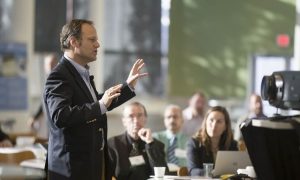

The Centre for Asian-Canadian Theology and Ministry at Knox College is hosting a seminar on May 28 on cross-cultural issues. The third and last in an annual series, the seminar aims to explore the histories of the Presbyterian Church in Canada along with those of the Korean, Ghanaian, Chinese and Taiwanese churches, and explore how these communities can share mission and ministry in the future.
ENI — Christians in Toronto commemorated the 200th anniversary of the law abolishing the slave trade in the then-British Empire, at a service in a church founded as the city's first black congregation in 1826.
ENI — Lent should be for penitence and fasting, and it should also be a time to live as the poorest people do and be united with them, say Roman Catholic labour activists in Hong Kong.
Mission, Evangelism and Growth in Eastern Han-Ca

The congregation of St. Timothy's, Toronto, is a close-knit group, enjoying retreats together, and celebrating special events such as Kwonsa installation, where women aged 45 and over are installed as unordained, elected officers who serve the church, especially by visiting infirm members. Photo - courtesy of St. Timothy's, Toronto
Though the wider church may know little about the Eastern Han-Ca Presbytery, the presbytery's members are eager to connect to other congregations and share their enthusiasm, projects and ministry with the national church. “We all try to have English ministry,” said Rev. In Kee Kim, minister at St. Timothy's, Toronto. “But we don't have enough younger adults who speak English. At St. Timothy's, we have three services — bilingual, Korean and English. We also have a communion and praise service that is in English. I think this trend will continue, because ultimately, we need to reach out beyond our own community.”
The Presbytery of Eastern Han-Ca (along with its Western counterpart) was created in 1997 after a multi-step process spanning several General Assemblies. The petition to create Han-Ca actually came to the 1995 assembly. A committee was struck to discuss the possibility, and later, a remit under the Barrier Act was sent down to presbyteries to make the change. Even after the Korean congregations got the go-ahead in 1997, the assembly instituted a five-year probationary period, with a report expected after three years. The assembly heard the report in 2002, and although concerns were expressed (such as feelings of isolation, lack of support from the wider church, lack of knowledge about church polity, a disconnect between first- and second-generation Koreans, and the role of women — all of which were evident before creating Han-Ca), the church decided to allow Han-Ca presbyteries to exist indefinitely. To ensure that concerns are not forgotten, assembly agreed to strike another committee at the 2010 assembly, which will report two years later on how the Han-Ca presbyteries and the entire church have acted on these issues.
“There was a huge celebration,” said Kim, speaking of the day when the motion passed. Kim was intimately involved in the entire Han-Ca creation process. “We didn't think it would pass.”
Since that day, while strides have been made in some areas, the presbytery struggles with creating connections with the wider church — and the church has struggled with how to include its Korean-Canadian members. At last year's assembly, several commissioners did not attend, sparking angst on both sides.
“A lot of people have a misunderstanding of Han-Ca. They see it as separation,” said Kim. “For more than 30 years, it had been a part of the English-speaking presbyteries. But only about 10 to 20 per cent actually participated in their presbyteries. They had no clue; it's a totally different community.”
Creating the Han-Ca (“Korean-Canadian”) presbyteries gave Koreans a place to meet where language and culture were mostly uniform. With that in place, Kim said the first task was to teach members about church polity.
“Congregation members didn't know they were part of a presbytery. They didn't know the Book of Forms. They didn't know they were governed by it,” he said. “The congregations were even separated from each other. We wanted the presbytery to be able to bring us together, to be united, to be connected.”
Now, he said, participation at presbytery is 100 per cent, and the Book of Forms is followed. “And the congregations are connected. One's problems and issues become our problems and issues. United life is the exercise.
“Our next issue is, how can we be connected further with the larger body of this church? We're praying about it and reflecting on it.”
Some would argue that the insular environment that ensued with the presbytery's creation, in some ways, exacerbated the problems.
“People come to feel secure, safe and comfortable, and once they find that, they don't want to come out,” said Rev. Cheol Soon Park, presbytery clerk and minister at Toronto Korean. “So we're encouraging them to interact with other congregations and to be exposed to broader aspects of Canadian society so they learn, grow and contribute. We try to push them into the field, but it's not an easy task.”
Issues around communication were on full display at last year's General Assembly, when several commissioners from the presbytery failed to show up. Commissioners on the floor expressed disapproval for the apparent lack of reverence for the church's annual proceedings. A letter arrived the next day, explaining their absence. It said the elders who failed to attend were first generation immigrants and were not able to be away from their businesses for more than one or two days at a time. “It is hard to find people with willing hearts,” stated the letter. “I will try again next year, and hope to find those who are willing to participate.”
A miffed assembly voted to record “its disappointment and dismay that seven of the 10 commissioners from the Presbytery of Eastern Han-Ca were not present for the deliberations and work of the assembly.” The moderator was also instructed to write a letter to the presbytery reminding the absent commissioners that “they failed to uphold their responsibilities to take part in the church's decision-making.”
As a result, a motion was passed to have Korean translation available at all future assemblies, beginning in 2007.
The incident at assembly was a poignant reminder of the divide between Eastern Han-Ca and The Presbyterian Church in Canada.

“Korean congregations have largely been ignored,” said Kim, of the church's response to the Korean church before Han-Ca was created. “There was no issue made that Korean congregations did not participate in presbytery. When the idea came up to create Han-Ca, a lot of concerns were raised, but none were raised for 30 years before that! It's a very interesting phenomenon.”
Despite the absence of ties to the larger church, Han-Ca East is heavily involved in mission and ministry in Canada and abroad.
The Korean Family Ministry began in 1988 by a group of Christians who wanted to reach out. It is now run by Rev. Myung Chun Kim, who visits seniors' homes in the Toronto area to hold worship services, make personal visits, and even to bring authentic Korean food to those longing for traditional dishes. Although it began as a mission of the PCC, the program became incorporated as a nonprofit organization by the Ontario government in January.
The presbytery also has two mission congregations — a testament to its passion for planting new churches. The church in Nova Scotia serves the Korean population there, who previously had no Korean church to attend. A young minister was sent last year, and according to Kim, the congregation is growing rapidly.
The presbytery as a whole also supports various mission projects in Nicaragua, North Korea, China and South Africa, supports three overseas missionaries, and each congregation has its own mission projects and programs.

Kim travelled to Madagascar in February to continue a partnership that began last year. He established a connection with pastors and seminary students there, holding seminars for them. His congregation is also supporting the beginnings of a church in Kazakhstan. The project began with evangelism and Bible study, followed by several members travelling there for a mission trip, and culminating in the purchase of a building for the new congregation.
But even when it comes to mission, there is conflict between this presbytery and the national denomination. The presbytery's givings to Presbyterians Sharing are regularly below required amounts; but this doesn't mean that Han-Ca East's congregations aren't donating time and money to mission.
“Korean churches do not find projects in the PCC that suit their focus and needs,” said Kim, noting that many Han-Ca congregations are more conservative and evangelical than the rest of the church, giving them a more traditional understanding of mission. “But we do spend a lot of money on our own missions. Koreans get involved in mission projects outside the PCC.”
Kim said International Ministries is an area that the Korean church can participate in because every Korean congregation has international ministries of their own. “How do we bring the two together and let the church know we're giving a lot of money to these projects?” asked Kim.
“The PCC shied away from establishing churches through mission,” he continued. “They work with local partners and do projects, but Han-Ca's main focus is building churches.”
The Korean church also has a history of ministry with Aboriginal peoples. St. Timothy's has been meeting with the Rocky Bay First Nation for about three years, visiting the reserve to hold vacation Bible schools. The congregation also sent a member on the Mistawasis youth mission trip held yearly through Youth in Mission. Kim said that generally speaking, the Korean church has a good understanding of the feelings of isolation and segregation felt by many native people, “so when we go to a reserve, they look at us as one of them. They don't see us as being connected to the Presbyterian Church, so it's easier for us to be connected with them.”
Several congregations were also involved in MissionFest, held in Toronto in March. The huge conference is dedicated to inspiring, encouraging and educating people for mission. Several Korean congregations either helped to sponsor the event or were exhibitors. It's through events like this that the presbytery is trying to use its many ministers who are in their 40s to help attract younger and English-speaking Koreans, as well as build bridges between the English- and Korean-speaking worlds.
And though there are issues surrounding the place of women in the presbytery, a strong women's group exists. The Korean Women's Association is a member of the Women's Missionary Society, and also functions as a committee within the Han-Ca Presbytery. It is an association of all the women's groups in the Han-Ca congregations, is Korean-speaking, and both Han-Ca East and West have branches of this association within their presbyteries. Among other things, they focus on mission as well as leadership development among both clergy and the laity.
Supporting women leaders — and educating traditional Korean congregations on the roles women can and should play — is a key priority for the presbytery, according to Park. “We are still working on it,” he said. “We called two women ministers in our congregation, and they are first-generation Korean immigrants. This is a new beginning, and I hope in the near future, we'll have women elders in the congregations.”
Despite difficulties, the presbytery must be doing something right. Since 1998 (the first year that near-complete figures are available), Han-Ca East has grown from 979 members, 803 in attendance, and 270 adherents, to about 5,000 members and those in attendance, and nearly 4,000 adherents.
Park said his congregation is currently celebrating 40 years as part of the Presbyterian Church. With 12 paid staff, and talk of building an extension, Toronto Korean is shooting for growth. “We're in wonderful shape,” said Park. “We're concentrating on building a secure ministry team, training young leaders, setting up new missionary appointments, and helping new Korean immigrants settle into the community.”
With such potential for growth, one wonders what the future will hold.
“My wish,” said Kim, “is that we would all be connected, that all the barriers would be broken, and that we will be one body.”
Eastern Han-Ca by the numbers (2004/05 figures)
Charges: 17 (all single-point)
Vacancies: 0
Members: 4,935 (2005), 4,150 (2004)
Attendance: 5,054 (2005), 4,496 (2004)
Adherents: 3,795 (2005), 2,136 (2004)
Largest congregations by members: Toronto Korean (1,127), Vaughan Community (982), Westside Community, Mississauga (626)
Largest congregations by attendance: Toronto Korean (1,160), Westside, Mississauga (850), Vaughan Community (840)
Largest congregations by adherents: Westside, Mississauga (905), Westside Community, Mississauga (821), Toronto Korean (424)
Areas covered: Montreal, Toronto, Thornhill, Brantford, Chatham, Kitchener, London, Niagara Falls, Mississauga
This is the final profile of the church's 46 presbyteries.
Presbyterian congregations in Canada have almost doubled their givings to missions over the last 20 years. In 1985, according to data reported in the Acts and Proceedings of the General Assembly, Presbyterian congregations gave $9.5 million to missions (General Assembly budget, as Presbyterians Sharing was called at the time, Other Benevolences, and Women's Missionary Society/Atlantic Mission Society). In 2005, Presbyterian congregations reported giving $18.5 million to missions. What is striking about this $9-million increase is that $6 million went to Other Benevolences, to mission projects and initiatives outside the national church budget. Other Benevolences includes local food banks, Presbyterian World Service and Development, interdenominational mission efforts, congregational short-term mission projects, and so on.
ENI — Churches in England and Scotland are taking part in wedding fairs to encourage couples to get married and to do so by marching down the aisle rather than into a registry office.
A Huge Impact

Photo - istockphoto.com, Katya Zaytseva
Giving just a little can help others in a significant way. These three church members thought of an idea, and with the support of their congregations were able to share their care and talent across distances.
A growing experience
When Bob McDonald finished college, he embarked on a life-changing experience. In 1970, fresh from completing an agricultural technology diploma, McDonald journeyed to Ghana. He had applied to work for several church organizations closer to his hometown in Glencoe, Ont., but found volunteer work through CUSO — a Canadian global social justice organization.
He admits he had to check on a map to find the location of the small African country, and was unsure what to expect of his first trip away from home. “Once I got there, I just loved the country and I loved the people, and I really liked the work,” he says.
In the isolated northern part of the country where McDonald worked, the climate was extremely hot and the two seasons were rainy or dry. A Catholic mission sponsored his work, and he attended a Presbyterian church. “I ended up spending two more years there, and my heart has been there for the last 35 years,” he says.
For two years, McDonald helped work on small-scale projects to aid local agriculture by introducing plows, improving seed, promoting better chicken varieties and explaining methods to grow gardens in the dry season.
The most enjoyable part of the trip was working with others. “They are just incredible, happy people,” says McDonald.
In the 1980s, he started working with the local chapter of the Canadian Foodgrains Bank.
“I realized that there were other things we could do in Canada to help people in the Third World countries and I got involved with the Presbyterians Sharing part of our church,” he says.
In 2005, McDonald had the opportunity to return to Ghana when his youngest daughter was studying at a university in Accra. Rev. Theresa McDonald-Lee, one of his three daughters (and minister in Moncton) accompanied her father on the trip along with her husband.
McDonald's church in Glencoe supported a Change for Change fundraiser to buy soccer balls for schools in Ghana. “They needed something like that because they love playing soccer,” he says. “Ghana is soccer-crazy.”
McDonald saw the kids' happy response to the project when he delivered the 23 soccer balls to rural schools without equipment. He revisited the communities where he had worked and recognized some gardens still in use and noted changes in the urban landscape. “In some ways it was totally shocking, and in other ways it was what we expected.”
Working on the family farm in Glencoe, McDonald anticipates his next trip to Ghana. “I've got projects in the back of my mind that I saw this time when I went back that can be done. Not huge projects, but small-scale projects, and I would love to go back and get those going.
“Sometimes it doesn't take a huge amount of money to have a huge impact on people who have very little.”

Myanmar. Photo - istockphoto.com, Alan Tobey
Faraway friends
Anna McCoskery has never visited Myanmar (Burma), but she has helped a small village undergo significant changes. A member of West Adelaide, Kerwood, Ont., McCoskery was a delegate to Hungary for the World Alliance of Reformed Churches in 1997. Over lunch, she met Rev. Vahnei, a minister with the Mara Evangelical Church in Myanmar. He told her of his 10-day trek travelling by foot, rafts, and rowboats until he boarded a plane in Bangkok. “It was just fascinating,” she says. She kept in touch with him, and as president of the Sarnia WMS Presbyterial, McCoskery invited Vahnei to visit her in Canada and share his story.
People who met Vahnei and learned about his life were shocked to hear the oppressive conditions under Myanmar's military government. People live at a subsistence level, lacking water supply, health services, roads, electricity and mail service. Soldiers can visit the villages at any time and confiscate everything.
McCoskery and the West Adelaide congregation raised $1,000 with which the people of Pasei set up a gravity water system, purchasing plastic water pipe and cement. Women and children had previously spent two hours at night travelling up the mountain for fresh water. The gravity water system brings the water to a holding tank at the bottom of the mountain. Money left over from the water system allowed the villagers to buy a used rice-grinding machine and funds were forwarded to two other villages for their own water systems.
Vahnei said the water system increased villagers' sense of self-worth and of being cared for by others. “It's just amazing what that man [Vahnei] does,” says McCoskery, “He can stretch a dollar farther than anybody I know.”
McCoskery englarged photos sent to her by the villagers and toured the “water story” to several churches and nearby presbyteries. “People were just fascinated,” she says. “They couldn't believe what life was like there.” More donations were sent to help with a variety of projects. Loans were made to help women start small businesses, treated mosquito nets were provided for a small cost, water projects were started in other villages, and four women began nursing training.
In 2007, the Mara Evangelical Church will celebrate its Centennial of Christianity. With the help of artist Eileen Wilson, McCoskery sent a silk banner to symbolize the friendship between the Mara Christians and Canadians.
Though McCoskery says it would be too dangerous for her to travel there, she plans to continue her friendship with the people of Myanmar. In the basement of her church, village maps, photos and stories are on display.
McCoskery has travelled and worked overseas. A retired teacher, she says she enjoys attending conferences and meeting new people.
“I'm making a bit of a difference for them,” she says. “Not a lot, but a bit.”

Photo - istockphoto.com, England Designs
Comforting quilts
In Winnipeg, Helen Smith turned a hobby into helping hundreds of children have a warmer winter. Six years ago, she heard about the Linus Project, which provides homemade blankets to underprivileged children and children in crisis. Smith decided to start a Winnipeg chapter.
“It seemed like such a good thing to do,” she says. She suggested the idea to a couple of other women from St. Andrew's who were already in a quilting group, and the work began. Every Wednesday morning, Smith hosted the quilters at her house. “My basement was always in a mess, with quilting all over the place,” she says.
People donated quilts to her from across the province, including one Catholic group who made over 400 blankets. The unique blankets are quilted, knitted or crocheted in various colours and patterns. Sown into each blanket is a Linus tag with a picture of the Charlie Brown character carrying his security blanket and the words “Made with tender loving care for Project Linus.”
The blankets were delivered to children in need in Manitoba. Some were sent to women's shelters, the Ronald McDonald house, children living in poverty, the Aboriginal centre and children's hospitals.
A retired nurse and mother of five children, Smith says there is satisfaction in helping others and making kids happy. With more than 2,800 blankets distributed, Smith handed the project over to a new organizer at the end of 2005. “I'm a little too old now,” says the 84-year-old with a laugh, “for running around in my car all over.”
A Time of Respite
For many of us, summer, that much-anticipated season of warmth and light we're entering, is all too brief. Naturally, we'd like to savour it as much as possible. In order to really do so, though, we need to depart from our usual habits and routines.
Imitating Prey
Today is my day off and it snowed this morning, almost a foot in some places. Disgusted, I went to work. After lunch the snow stopped and I decided to leave the office and see if I could salvage the remains of the day. I went home, grabbed my fi eld glasses, my rambling rifle and the rest of my field kit.
ENI — Religious groups have joined civic groups and international companies that include Volvo and General Electric in backing The Path to Climate Sustainability by the Global Roundtable on Climate Change. The coalition of more than 150 groups is calling for governments to set “scientifically informed targets” for reducing greenhouse gases and carbon dioxide emissions.
Volunteers to be Agency's Focus
The way Mission is organized and delivered, who is involved, and how the national office engages participants, will undergo a massive shift, according to a document discussed at the church's national mission agency committee meeting.
Making God Smile
March lived up to its billing on its first day. Around noon a snowstorm roared into Toronto falling hard and fast. The city ground to a stop. My usual 22-minute commute home took about a hundred minutes. I got off easy — many many others were stuck for hours.
Making a World of Difference
“You must be the change you want to see in the world”
– Mahatma Gandhi
The Presbyterian Church is one of the most vibrant and active around the world, working in the fields of education, health, evangelism and peace. There are many partners in this work; national bodies, congregations and some special individuals who bring their own understanding of faith, justice and Christ to the unique communities in which they work. In the stories presented here, people have crossed borders and come to Canada to share their passion with local mission partners. If they didn't visit your congregation, read on — and learn how Presbyterians are truly making a difference.
Nigerian leader asks the difficult questions
Taiwanese women seek gender equality
Nigerian grows church through mission and evangelism
When Congregations Marry
Presbyterian and United Churches share a minister? Well, why not?
The Presbyterian Church recently signed a revised agreement between the federal government and the Interfaith Committee on Chaplaincy for Corrections Services Canada, an advisory group on the provision of religious and spiritual care to inmates and the oversight of federal prison chaplains. Rev. Will Ingram, a minister at Morningside High Park, Toronto, signed on behalf of the committee, along with Correctional Services Commissioner Keith Coulter. The document describes the relationship between the two organizations and outlines how chaplaincy services are provided in correctional institutions.
Rev. Dr. J. H. (Hans) Kouwenberg of Calvin Church, Abbotsford, B.C., has been named moderator-elect for the 2007 General Assembly this June in Waterloo, Ont. Kouwenberg came to his current charge after 20 years at St. Giles', Prince George, and has served on a number of the church's national committees. He has been clerk and moderator of synod and presbytery, is currently convener of the board of St. Andrew's Hall and a member of the Committee on Theological Education, and has been on the governing bodies of all three theological colleges. In 2005, Presbyterian College awarded him an honorary doctorate. He has also acted as chaplain for the Royal Canadian Legion and for correctional services. He currently teaches literature at a Bible college in Abbotsford. Kouwenberg will be officially installed as moderator at the assembly.
We Care and Share!
When you receive this issue of The Presbyterian Record, I will be representing The Presbyterian Church in Canada at the General Assembly of The Presbyterian Church in Taiwan. How exciting it will be for me to visit the church that I served for six years in the early 1970's. I served in Taiwan during a very difficult time; a time when the church was facing political and social persecution. Suffering continues because of Taiwan's position in the world today. I will share news of this visit in my final message in the June issue.
The possibility of general assembly meeting every other year garnered the most discussion at an otherwise low-key Assembly Council meeting in March.
A Real Culture Club
It's become popular not only to make fun of the church and people of faith, but to attempt to attack or topple Christian tenets. Books like The Da Vinci Code and documentaries claiming archeological discoveries of the bones of Jesus and his family appear to threaten the very foundations of the Christian church. Our society has forgotten and neglected its roots, and we've lost the Sabbath. Church has moved from the essential institution at society's hub to a blip on the weekend radar, wedged between hockey practice and the scratch-and-save sale at Sears.